

You hire someone. You agree on pay. You run payroll. Money goes out. Everyone’s happy.
And then a letter shows up. Or your payroll provider flags something. Or your bookkeeper asks why your payroll taxes don’t match your filings. And now you are in the fun little world of penalties, interest, amended returns, and spending your Friday uploading PDFs into a government portal.
So this is a practical post. Not theory. Not a “payroll is important” pep talk.
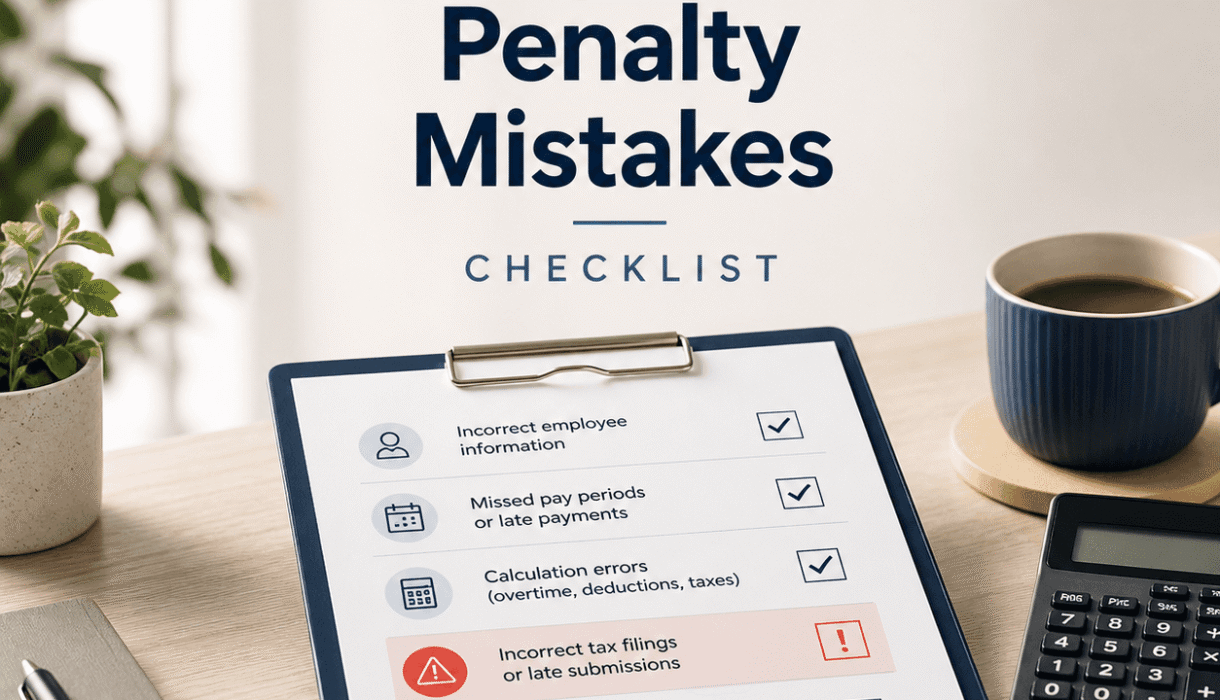
It’s a list of the payroll mistakes that most often trigger penalties, plus a checklist you can literally copy into your notes and use each payroll run, each month, each quarter.
If you want a second set of eyes on your payroll setup or your QuickBooks file, Smart Bookkeeping Partner offers a free QuickBooks health check. It’s exactly what it sounds like. What’s being recorded. What’s reconciled. What’s off. And what needs cleanup. More on that near the end.
Why payroll penalties happen so easily
Because payroll has deadlines stacked on deadlines.
And it mixes a bunch of moving parts:
- employee classification
- wage rules
- benefit deductions
- tax deposits
- quarterly filings
- annual filings
- agency notices
- and a general assumption from the IRS and states that you should have known better
Even if you have a payroll software, or a provider, the liability often still sits with the business.
So let’s get into the mistakes.
1. Missing payroll tax deposit deadlines
This is the big one. The most common. And the one that gets expensive fast.
Payroll taxes are not paid when you file the quarterly return. They are deposited on a schedule.
Depending on your lookback period and federal rules, you might be:
- monthly depositor
- semiweekly depositor
- next day depositor (for large payroll events)
And states have their own schedules too.
If you miss a deposit, the IRS can assess a failure to deposit penalty, often starting around 2 percent and stepping up the later you are. Then interest stacks on top. And if you keep missing, they can move you to a more frequent deposit schedule.
What causes it in real life:
- you ran payroll late and assumed the deposit moves with it
- your payroll software was not set to auto remit
- your bank account did not have enough cash on deposit day
- you switched providers and deposits did not transfer correctly
- someone assumed the quarterly filing “covers it”
Image suggestion: Screenshot style image of a simple calendar showing payroll day, tax deposit day, and filing due dates.

2. Filing payroll returns late (or not filing at all)
Deposits are one thing. Filings are another.
Common filings include:
- Form 941 quarterly (most employers) – Learn more about Form 941 here
- Form 940 annually (FUTA)
- state unemployment returns
- state withholding returns
- local filings if applicable
Even if you paid everything perfectly, late filing penalties can still apply. And if you did not pay everything, late filing plus late payment can stack.
Common trigger: “We stopped running payroll so we didn’t file.”
If you have an open account with an agency, they often still expect filings, even if zero. You usually need to file a final return and formally close accounts.
Image suggestion: A simple table graphic of filing types and due dates (quarterly, annual).

3. Misclassifying workers (W2 vs 1099)
This one is painful because it can go back years.
If someone should be an employee and you pay them as a contractor, you may be on the hook for:
- back payroll taxes (employer and employee portions)
- penalties and interest
- potential wage and hour issues
- state unemployment issues
- workers comp issues
And yes, even if the worker “asked to be 1099.” That does not decide it.
Common misclassifications:
- a full time admin assistant paid as contractor
- an “independent” manager who works set hours under your direction
- a worker using your tools, your processes, your schedule
If you are not sure, get advice before you set them up. Fixing it later is worse.
4. Paying owners incorrectly (S corp, partnership, sole prop)
Owner payroll is where I see a lot of messy stuff.
S corporation owners
S corp owners who work in the business generally need a reasonable salary reported on a W2. Taking only distributions can trigger IRS scrutiny and back payroll taxes.
Partnerships
Partners typically do not run through W2 payroll. They usually take draws and receive K 1 income. Sometimes you use guaranteed payments. It’s different.
Sole proprietors
Sole props generally do not pay themselves payroll. They take owner draws. Payroll is for employees.
The penalties here often show up as incorrect filings, incorrect tax treatment, or mismatched books.
If your payroll and bookkeeping are not aligned, your CPA ends up doing cleanup in March. And you end up paying for it.
5. Using the wrong state (or locality) tax setup
Remote work and multi state hiring made this way more common.
Where is the employee physically working? That matters for:
- state withholding
- state unemployment
- local taxes in some areas
- nexus and registration requirements
Common mistake: employee moved and nobody updated payroll.
Now you withheld the wrong state for 6 months.
Fixing it can mean amended returns, refunds, and paying another state what you should have paid.
6. Not registering agency accounts before running payroll
This happens with new businesses and fast hires.
You run payroll in software, it calculates taxes, maybe it even “pays” them in the system, but you never actually registered:
- state withholding account
- state unemployment account
- local account if needed
So deposits might not go through correctly, or filings can’t be accepted, or notices show up because the agency has no record of the account.
This is one of those boring admin steps that saves you a lot of pain later.
7. Incorrect taxable wage calculations (benefits, reimbursements, deductions)
Payroll taxes are based on taxable wages. Taxable wages are not always “gross pay.”
Common things that cause mistakes:
- health insurance handled incorrectly (pre tax vs after tax)
- HSA contributions mis coded
- retirement deductions not set up properly
- personal use of company vehicle not added to taxable wages
- imputed income for certain benefits not included
- reimbursements paid without an accountable plan, making them taxable
Sometimes the error is small per paycheck. But it compounds over a year. Then W2 time comes and numbers don’t tie.
8. Not tracking overtime correctly
Wage and hour penalties are not always “payroll tax penalties” but they still cost money. And they often start because payroll was run incorrectly.
Overtime rules can vary by state, but the general issue is:
- you did not pay time and a half when required
- you calculated the regular rate wrong (bonuses can affect it)
- you treated someone as salary exempt when they were not
This can trigger back wages, penalties, and in some cases legal claims.
If you have hourly staff and you’re unsure about overtime rules, it’s worth tightening this up.
9. Rounding time in a way that creates underpayment
Yes, rounding time can be legal. But it must be neutral over time.
The mistake is when rounding consistently benefits the employer, for example always rounding down, or using “estimated hours” instead of actual time.
It seems tiny. Then it becomes a pattern. Patterns are what audits love.
10. Incorrect new hire reporting
Many states require new hires to be reported within a set timeframe.
This is usually simple. Many payroll systems do it. But if you do manual payroll, or you onboard people outside the system, it can be missed.
Penalties vary, but the real issue is it signals sloppy compliance. And it’s easy to avoid.
11. W2 and 1099 mistakes at year end
Year end is where all the little mistakes show up.
Common issues:
- employee address or SSN incorrect
- wages on W2 do not match the 941 totals
- benefits not reflected correctly in boxes
- 1099 contractor paid via credit card incorrectly included (card payments are generally reported on 1099 K, not 1099 NEC)
- late distribution of W2s or 1099s
Also, states have their own W2 filing requirements. Some are linked to federal filings, some are separate.
Image suggestion: A year end checklist graphic for W2/1099.

12. Not reconciling payroll liabilities in your bookkeeping
This is the silent killer.
Your payroll reports can look fine. Your bank account can show deposits going out. But your books can still be wrong.
In QuickBooks, payroll creates liability accounts like:
- federal withholding payable
- Social Security payable
- Medicare payable
- state withholding payable
- unemployment payable
- benefits payable
If those do not reconcile to what you actually owe and what you actually paid, you can end up with:
- unpaid liabilities sitting in the background
- double payments
- incorrect expense reporting
- notices that surprise you months later
This is why “clean, reconciled books” matters. It is not just bookkeeping perfectionism. It’s how you catch payroll issues early, while they are still fixable.
You can use this as:
- a per payroll run checklist
- a monthly review
- a quarterly close out
- and a year end wrap
Each payroll run
- Employee vs contractor classification confirmed for any new worker
- New hire onboarding complete (W4, I9, state forms, new hire reporting)
- Pay rates checked (hourly, salary, bonuses, commissions)
- Timecards approved, overtime rules applied correctly
- Pre tax and post tax deductions coded correctly (insurance, retirement, HSA)
- Reimbursements run through an accountable plan process (or treated correctly if taxable)
- Payroll processed on time, funding confirmed in bank account
- Tax payments set to auto remit or deposit dates scheduled and confirmed
Monthly
- Payroll tax deposits confirmed as cleared in bank feed
- Payroll liability balances reviewed in bookkeeping software (no strange negatives, no growing balances)
- Benefits and retirement payments matched to actual invoices and payments
- Any employee address changes or state work location changes updated
Quarterly
- Form 941 reviewed before filing (wages, tips, taxable Social Security and Medicare)
- State withholding returns filed and paid
- State unemployment returns filed and paid
- Reconcile 941 totals to payroll summary reports
- Confirm deposit schedule still appropriate (especially after growth)
Year end
- Employee names, addresses, SSNs verified
- Contractor W9s collected and TINs verified
- W2 totals tie to quarterly filings (941s) and payroll reports
- 1099 totals verified and separated by payment type (ACH/check vs card platforms)
- W2s and 1099s issued and filed by deadlines
- Any agency accounts closed properly if no longer active
A quick note on “my payroll provider handles that”
Sometimes yes. Sometimes mostly.
But even with a provider, the most common failure points are still on the business side:
- incorrect setup info
- wrong work location
- misclassification
- cash not available on debit date
- benefits entered incorrectly
- notices not responded to
Payroll providers process what you feed them. They do not always validate your business reality.
What I’d do if you’re worried you already have payroll issues
If you suspect problems, don’t wait until year end. Year end turns small mismatches into big cleanup.
Here is a simple triage plan:
- Pull your last 3 months payroll reports, plus bank transactions for tax deposits.
- Check if deposits match what payroll says was remitted.
- In QuickBooks, open your payroll liability accounts and see if anything is piling up.
- If you got notices, open them. Read them. The clock is always ticking.
- If something doesn’t tie, fix it now, not later.
If you want help with that review, Smart Bookkeeping Partner can walk through your QuickBooks setup and highlight what’s reconciled, what’s not, and what needs cleanup. You can start with the free QuickBooks health check at https://smartbookkeepingpartner.com/. Or call 985-401-1210 if you’d rather just talk it through.
Let’s wrap this up (before you get another notice)
Payroll penalties usually come from a few repeat offenders.
Missed deposits. Late filings. Wrong worker classification. Wrong state setup. Owner payroll done incorrectly. Benefits coded wrong. And the big quiet one. Not reconciling payroll liabilities inside the books.
Use the checklist. Even if you have a payroll provider. Especially if your business is growing and payroll is getting more complex.
And if you want, get your books checked. Clean, reconciled books are not just neat. They are protective. They tell you when payroll is drifting off course, before the IRS does.
FAQs (Frequently Asked Questions)
Why do payroll penalties happen so easily?
Payroll penalties occur easily because payroll involves multiple deadlines and moving parts such as employee classification, wage rules, benefit deductions, tax deposits, quarterly and annual filings, agency notices, and the assumption that businesses should be aware of these requirements. Missing any of these can trigger penalties, even if you use payroll software or providers, since liability often remains with the business.
What is the most common payroll mistake that leads to penalties?
The most common payroll mistake causing penalties is missing payroll tax deposit deadlines. Payroll taxes must be deposited on specific schedules (monthly, semiweekly, or next day depending on your situation), not just when filing quarterly returns. Missing deposits can result in failure to deposit penalties starting around 2%, plus interest, and may cause the IRS to require more frequent deposits.
What happens if I file payroll returns late or fail to file them at all?
Filing payroll returns late or not filing can lead to significant penalties even if all payments were made correctly. Common filings include Form 941 quarterly, Form 940 annually (FUTA), state unemployment returns, and state withholding returns. If you stop running payroll but keep accounts open with agencies, you still need to file returns—often zero returns—and formally close accounts to avoid penalties.
How does misclassifying workers affect my payroll and taxes?
Misclassifying employees as independent contractors (W2 vs 1099) can cause serious issues including owing back payroll taxes for both employer and employee portions, penalties, interest, wage and hour violations, state unemployment problems, and workers’ compensation issues. Worker classification depends on factors like control over work hours and tools used—not just worker preference—so it’s important to classify correctly from the start.
What are the common mistakes related to paying business owners through payroll?
Common errors include S corporation owners not paying themselves a reasonable salary reported on a W2 and taking only distributions—which can trigger IRS scrutiny and back taxes. Partnerships typically do not run owner payroll but take draws or guaranteed payments instead. Sole proprietors generally do not pay themselves through payroll but take owner draws. Incorrect treatment leads to filing errors and bookkeeping mismatches that cause costly cleanup later.
How does using the wrong state or locality tax setup affect my payroll compliance?
Using incorrect state or local tax settings is increasingly common due to remote work and multi-state hiring. Payroll tax obligations depend on where an employee physically works. Misapplying state or local tax rules can result in incorrect filings, missed tax payments, penalties from tax authorities, and complications in reconciling books. Ensuring accurate location-based tax setup is essential for compliance.