
If you have ever opened your financials and immediately scrolled past the balance sheet like, nope. Not today. You are not alone.
Profit and loss statements feel familiar. Revenue in. Expenses out. Easy enough.
A balance sheet feels like a different language. Assets, liabilities, equity. “As of” some date. And somehow it’s supposed to explain what your business is worth, what you owe, and whether you are actually stable.
So let’s make it simple. Not dumbed down. Just… human.
By the end of this, you should be able to look at a balance sheet and quickly answer:
- What do we own right now?
- What do we owe right now?
- What is left over for the owner?
- Are the numbers even believable?
And if you use QuickBooks, you will also know what to click, what to question, and what usually goes wrong behind the scenes.
A balance sheet is a snapshot. Not a story.
A profit and loss statement covers a period. Like a movie.
A balance sheet is a photo. One moment in time.
That’s why it says “As of” at the top.
If you ran a balance sheet “as of today”, it’s showing what you have and what you owe at that exact moment. Not what happened this month. Not what you earned this quarter. Just. Right now.
This is also why balance sheets are incredibly good at catching messes. Because they cannot hide as easily as your P and L can.
Understanding this concept is crucial because financial literacy empowers you to make informed decisions about your business’s financial health.
The only formula you need
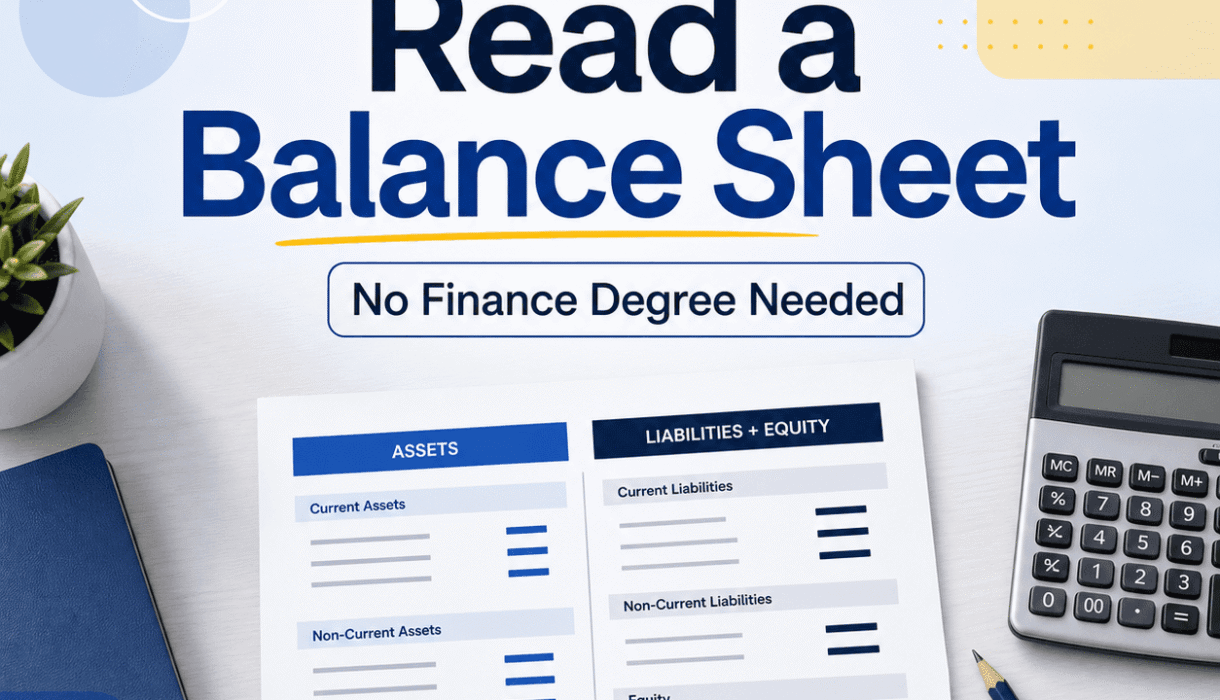
Here’s the entire balance sheet in one line:
Or the version I like better:
What you have = What you owe + What’s left for you
That’s it.
If that equation is not true, the balance sheet is broken. Full stop.
Quick mental picture
Imagine you are selling your business today.
- Assets: everything you could sell or collect
- Liabilities: everything you must pay off
- Equity: what you would keep after paying everyone else
Not perfect, but close enough to make the page feel less abstract.
The three big sections (and what they actually mean)
Most balance sheets are split into:
- Assets
- Liabilities
- Equity
Let’s break them down without the textbook vibe.
1. Assets: stuff you own or will receive
Assets are resources the business controls.
On most small business balance sheets, assets usually include:
- Bank accounts
- Accounts receivable (customers who owe you money)
- Inventory (if you sell products)
- Prepaid expenses (you paid for something that applies to the future)
- Fixed assets (equipment, vehicles, furniture)
- Undeposited funds (common in QuickBooks)
Image: balance sheet sections overview
(If you do not have an image library yet, this is a good one to create. A simple graphic with three labeled buckets works great.)
Current vs long term assets
You’ll often see assets split into:
- Current assets: expected to turn into cash within 12 months
- Long term assets: stuff that sticks around longer than a year (like equipment)
This split matters because it tells you how quickly you can access cash if you need it.
What to check first in Assets (the fast scan)
If you want the 20 second version:
- Does your bank balance match your actual bank?
- Is accounts receivable realistic, or does it include old uncollectible invoices?
- Is undeposited funds sitting there forever (a big red flag)?
- Is there a weird account called “Ask My Accountant” or “Suspense” holding mystery transactions?
If any of those feel off, the rest of the balance sheet becomes questionable.
2. Liabilities: what you owe
Liabilities are obligations. Bills you have to pay. Money you borrowed. Taxes you owe.
Typical liabilities:
- Accounts payable (bills you owe vendors)
- Credit cards
- Loans
- Payroll liabilities (taxes and withholdings not yet paid)
- Sales tax payable
- Unearned revenue (client paid you but you have not delivered yet)
Current vs long term liabilities
Same split idea:
- Current liabilities: due within 12 months
- Long term liabilities: due after 12 months
A business can be profitable and still get squeezed if current liabilities are heavy and cash is light. Balance sheets show that problem quickly.
Image: liabilities examples
3. Equity: what’s left after you pay everyone
Equity is the section that confuses people, mostly because it’s not a “real” bank account or a bill. It is the leftover bucket.
For small businesses, equity often includes:
- Owner contributions (money you put in)
- Owner distributions (money you took out)
- Retained earnings (prior years’ profit that stayed in the business)
- Net income (current year profit, sometimes shown separately)
Here’s the key point
Equity is not the value of your business on the open market.
It’s the accounting value: assets minus liabilities.
Still very useful. Just different from “what could I sell this company for”.
How to read your balance sheet in 7 steps (in order)
This is the exact order I recommend if you want to make sense of it without spiraling.
Step 1: Confirm the date
At the top it should say something like:
Balance Sheet
As of October 15, 2026
If you’re comparing months, you need two different “as of” dates.
Step 2: Look at cash first
Cash is usually the most accurate account, assuming reconciliation is happening.
On the balance sheet it could be listed as:
- Checking
- Savings
- Money market
- PayPal, Stripe balance, etc.
If your books are not reconciled, cash is not reliable. And if cash is not reliable, everything else becomes “maybe”.
If you are not sure whether your QuickBooks is truly clean, Smart Bookkeeping Partner offers a free QuickBooks health check, which is basically a sanity test for how your transactions are recorded and what is actually reconciled. You can find it at https://smartbookkeepingpartner.com/.
Step 3: Scan accounts receivable (A/R)
A/R is money customers owe you.
Questions to ask:
- Is A/R mostly recent invoices?
- Or is it stuffed with 6 month old invoices you will never collect?
If A/R is inflated, your business looks healthier than it is.
A quick fix is not “delete the invoices”. It’s to clean up properly. Write offs, credits, payments recorded correctly. This is where bookkeeping quality really shows.
Step 4: Check accounts payable (A/P)
A/P is what you owe vendors if you are entering bills.
Common issue: some businesses pay everything through the bank feed and never use the Bills feature. Then A/P may be zero even though you have vendor obligations. Not necessarily wrong. Just means you are not using that workflow.
The bigger issue is when A/P shows ancient bills you already paid but they were never linked correctly.
Step 5: Look at debt and credit cards
Loans and credit cards should be believable. This is where you catch:
- Payments categorized as expenses instead of split between principal and interest
- Loan balances that never change (something is being booked incorrectly)
- Duplicate credit card accounts in QuickBooks
Step 6: Scan payroll liabilities (if you run payroll)
If you have employees, payroll liabilities matter a lot.
You might see accounts like:
- Federal withholding payable
- Social Security payable
- Medicare payable
- State withholding payable
- SUTA payable
These should not grow forever. They should rise each payroll, then drop when payments are made to agencies.
If you are setting up payroll or thinking about switching providers, Gusto is a solid option for many small businesses.
Smart Bookkeeping Partner has a referral promo for new Gusto clients: when you sign up using this link, after your first paid bill you will receive $200 worth of gift cards:
https://gusto.com/r/everylanne4b19bb6
(Keep that link bookmarked if payroll is on your to do list. It’s one of those easy wins.)
Step 7: Look at equity, but do not panic
Owners often see equity go negative and assume disaster. Sometimes it is a real problem. Sometimes it’s just how things have been recorded.
Equity can be distorted by:
- Owner draws recorded inconsistently
- Personal expenses mixed into business without a clear method
- Old opening balance issues when QuickBooks was first set up
- Prior year adjustments not posted correctly
If equity looks bizarre, do not “fix” it by random journal entries. That’s how the mess becomes permanent.
The most common balance sheet accounts, translated
Let’s decode a few you will probably see.
Undeposited Funds
In QuickBooks, this is basically “payments received but not deposited yet”.
If you use QuickBooks Payments or you batch deposits, this can be normal.
If Undeposited Funds is huge and has been huge for months, usually it means:
- Payments were recorded, but deposits were not matched properly
- Deposits were recorded twice
- Sales receipts are sitting there with no matching bank activity
Prepaid Expenses
You paid cash now, but the benefit happens later. Examples:
- Annual insurance paid upfront
- A software subscription paid for the year
Not every small business needs to track these perfectly, but it should not be random. If it’s random, it becomes a junk drawer account.
Fixed Assets and Accumulated Depreciation
Fixed assets are longer term purchases like equipment. Accumulated depreciation is the accounting reduction over time.
If you have no idea what is in there, you are not alone.
Just know this: fixed assets should not be stuffed with everyday purchases like small tools or routine repairs. And depreciation should typically be managed consistently, often with help from your tax pro.
Retained Earnings
This is basically “prior years profits minus prior years losses, after owner activity is accounted for”.
It updates when the year closes.
In QuickBooks, retained earnings can look wrong if:
- Prior year transactions were edited after taxes were filed
- Cleanup was done without a clear cutoff
- Opening balances were set incorrectly
A tiny example (so you can see it work)
Let’s say your balance sheet shows:
Assets
- Cash: $40,000
- Accounts receivable: $15,000
- Equipment: $10,000
Total assets: $65,000
Liabilities
- Credit card: $7,000
- Loan: $18,000
Total liabilities: $25,000
Equity Total equity: $40,000
And yes, it balances because:
65,000 = 25,000 + 40,000
What does that actually tell you?
- You have $40k cash, good.
- But $15k of your “assets” is money you have not collected yet. Some of it might be slow.
- You owe $25k.
- After paying off everything today, you would have $40k left on paper.
Now. Is that “good”? Depends on your business. But it is understandable. You can reason with it.
What a “healthy” balance sheet tends to look like (for small businesses)
Not strict rules, more like signals:
- Cash is positive and not constantly near zero
- A/R is mostly current, not ancient
- Credit cards are not carrying mystery balances
- Loan balances decrease over time in a predictable way
- Payroll and sales tax liabilities do not pile up unpaid
- No giant Uncategorized Expense or Suspense accounts
- Equity doesn’t swing wildly month to month unless something major happened
Image: healthy vs messy balance sheet visual
The truth: balance sheets are only as good as your bookkeeping
This is the part most people learn the hard way.
A balance sheet is not hard because you are not smart enough.
It’s hard because if the books are messy, the balance sheet becomes fiction. And you are trying to interpret fiction like it’s fact.
Some very normal reasons your balance sheet might be misleading:
- Bank accounts not reconciled
- Old transactions edited without a process
- Duplicate income entries from payment apps
- Loans booked as income (yes, it happens)
- Personal expenses mixed in with no consistent method
- Payroll liabilities not tied out to actual filings and payments
If you want a clean baseline, Smart Bookkeeping Partner’s approach is basically: clean, reconciled books first, then advisory layer on top. Forecasting, cash flow monitoring, KPI tracking, profitability analysis, targets. All the stuff business owners actually want. But it only works if the foundation is real.
You can start with their free QuickBooks health check at https://smartbookkeepingpartner.com/ or call 985-401-1210.
A quick “balance sheet confidence” checklist (print this mentally)
When you open your balance sheet, ask:
- Is every bank and credit card account reconciled through last month?
- Does A/R tie to real open invoices you expect to collect?
- Does A/P tie to real unpaid bills (if you use bills)?
- Do loan balances match lender statements?
- Do payroll liabilities go up and down, not just up?
- Is Undeposited Funds small and recent?
- Are there any weird accounts with big balances and vague names?
If you answer no to two or more, your next step is not “analyze harder”.
Your next step is cleanup.
Wrapping up (and what to do next)
Reading a balance sheet without a finance degree is mostly about knowing what to look at first, and not getting distracted by the labels.
Remember:
- It is a snapshot, not a story.
- Assets are what you have.
- Liabilities are what you owe.
- Equity is what’s left.
- And the whole thing only works if the books are clean and reconciled.
If you want a second set of eyes on your QuickBooks setup, or you suspect your balance sheet is technically balancing but still wrong, you can start with the free QuickBooks health check at https://smartbookkeepingpartner.com/.
And if payroll is part of what you’re setting up this year, here’s that Gusto referral link again. After your first paid bill, you’ll get $200 worth of gift cards:
https://gusto.com/r/everylanne4b19bb6
FAQs (Frequently Asked Questions)
What is a balance sheet and how is it different from a profit and loss statement?
A balance sheet is a financial snapshot showing what your business owns, owes, and the owner’s equity at a specific moment in time, indicated by the “As of” date. Unlike a profit and loss statement, which covers income and expenses over a period (like a movie), the balance sheet is like a photo capturing one exact moment.
What is the fundamental formula behind a balance sheet?
The core formula of a balance sheet is: Assets = Liabilities + Equity. In simpler terms, what you own equals what you owe plus what’s left over for you as the owner. If this equation doesn’t balance, the balance sheet is incorrect.
What are the three main sections of a balance sheet and what do they represent?
The three big sections are: 1) Assets – resources your business owns or will receive; 2) Liabilities – obligations or debts your business owes; and 3) Equity – the leftover value for the owner after paying off liabilities. Each section provides insight into different aspects of your business’s financial health.
How do current assets differ from long-term assets on a balance sheet?
Current assets are resources expected to convert into cash within 12 months, such as bank accounts and accounts receivable. Long-term assets are items like equipment or vehicles that remain with the business longer than a year. This distinction helps assess how quickly you can access cash if needed.
Why is equity on the balance sheet not the same as the market value of your business?
Equity represents the accounting value calculated as assets minus liabilities. It reflects what’s left over for owners based on bookkeeping records, but it does not equate to what your business might sell for on the open market, which considers many other factors beyond accounting numbers.
What should I look for first when reviewing my balance sheet to ensure accuracy?
Start by confirming the date to understand the snapshot timing. Then check cash balances against actual bank statements, evaluate if accounts receivable are realistic (excluding old uncollectible invoices), watch for undeposited funds sitting too long (which can be red flags), and investigate any mysterious accounts like “Ask My Accountant” or “Suspense” that may hold unclear transactions.