
Most business owners I talk to think they “need a budget.”
And I get it. Budgeting is the thing you are supposed to do. It sounds responsible. It sounds like you are in control.
But here’s the honest version.
A budget is often a document you make once, feel good about for 12 minutes, and then ignore while real life does whatever it wants.
A forecast is the one you actually use.
Not always. Not in every situation. But if you are trying to make decisions month to month, protect cash, plan hiring, set targets, and not feel surprised every time you open your bank account… yeah. Forecast wins.
Let’s break it down in a way that doesn’t feel like finance homework.

What a budget actually is (and why it feels so strict)
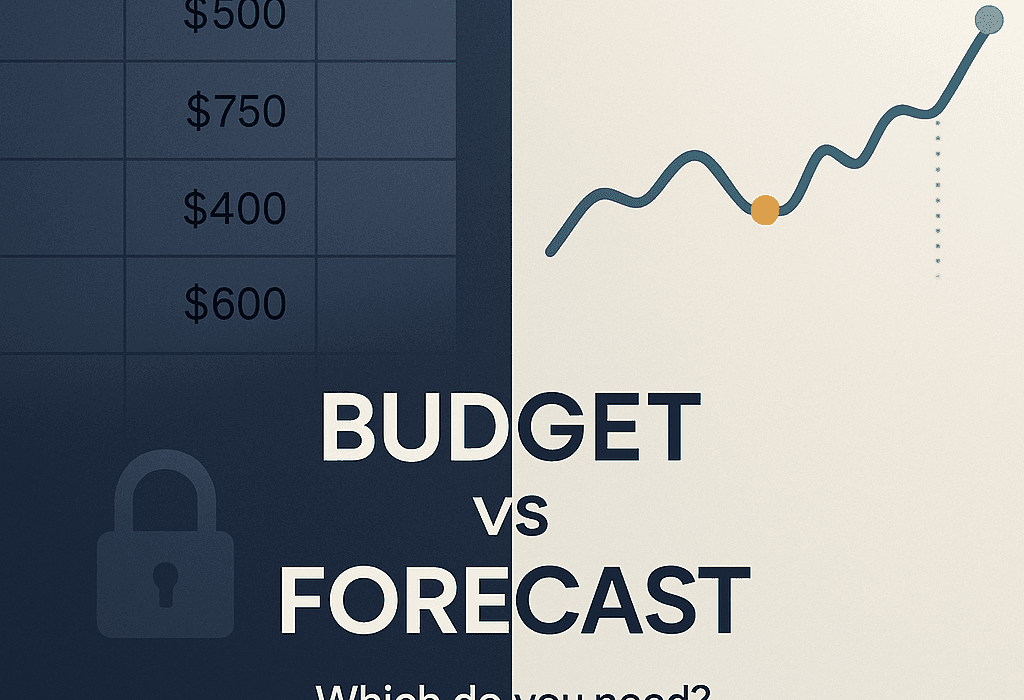
A budget is a fixed plan.
Usually it’s made for the year. Sometimes for the quarter. It says:
- We will make $X in revenue
- We will spend $Y on payroll
- Rent is $Z
- Marketing is this
- And we’ll totally hit a profit margin of 22% because… optimism
Budgets are great for a few things:
- Setting intention (especially if you’ve never tracked numbers before)
- Establishing spending boundaries
- Getting aligned with a partner, leadership team, or investors
- Pricing decisions, if you’re working backward from margins
But budgets have a built-in problem.
They assume the world stays fairly predictable.
And if you own a small business, you already know that’s not how this works.
A client pauses. A big invoice gets delayed. Your top employee leaves. Your ad costs double. You need a new laptop. Suddenly the budget is either wrong or it makes you feel like you’re failing.
You’re not failing. The budget is just… rigid.
This rigidity can be alleviated by embracing more flexible financial strategies such as forecasting, which allows for adjustments based on real-time data and circumstances. Additionally, implementing effective cost control mechanisms can help manage expenses more efficiently while still allowing for some level of unpredictability in business operations.
What a forecast is (and why it feels more useful)
A forecast is a living prediction.
It answers questions like:
- Based on what’s happening right now, what will the next 3 months look like?
- If sales dip 10% in August, are we okay?
- If we hire a part time admin in September, what happens to cash?
- If we raise prices, when do we feel it?
- Can we afford payroll comfortably, or is it going to get tight?
A forecast gets updated. A lot.
Monthly is common. Sometimes weekly if cash is tight or the business is growing fast.
It’s less about “this is the plan” and more about “this is what’s likely, given current reality.”
And that’s why business owners actually use it.

Budget vs Forecast: the simplest comparison
Here’s the clean way to think about it:
| Feature | Budget | Forecast |
| Purpose | Set targets and boundaries | Predict and adjust based on reality |
| Frequency | Usually annual | Updated regularly (monthly or more) |
| Flexibility | Fixed | Flexible |
| Best for | Spending control, goal setting | Decision making, cash planning, growth planning |
| Emotional impact | Can feel like a report card | Feels like a dashboard |
If you only pick one tool to run your business better, pick the one that helps you make decisions before you get stuck.
That’s the forecast.
The uncomfortable truth: most budgets don’t survive Q1
You start the year with a plan.
Then January happens. Then February. Then March. And by the time Q2 hits, you’ve already got:
- one surprise expense
- one client that didn’t renew
- one “this was supposed to be a slow month but it wasn’t” situation
- one payroll change
- one tax payment you didn’t think about enough
So the budget becomes background noise.
I’m not saying budgets are useless. I’m saying a budget without an updated forecast is like using last year’s GPS directions. You might get there. Or you might end up in a lake.
When you actually do need a budget
Ok, fair. There are times a budget is the right tool.
1. You’re trying to cut spending (on purpose)
If you know you’re leaking money and you need constraints, a budget creates guardrails.
2. You have departments or managers spending money
Budgets are useful for accountability.
3. You’re presenting numbers to a lender or investor
They often expect a budget, even if you also provide forecasts.
4. You’re building a compensation plan or bonus targets
Budgets help define baseline expectations.
But even in these cases, the smartest setup is usually: budget for the year, forecast every month.
Budget = the target. Forecast = the steering.
When forecasting is non negotiable
If any of these are true, you need forecasting more than budgeting.
You’ve ever said “we’re profitable but cash is tight”
Classic. And it’s fixable. But not with a static budget.
Your revenue is seasonal or inconsistent
Forecasting is basically a survival tool here.
You’re considering hiring
Payroll is usually the biggest expense. Forecasting makes sure you’re not hiring based on vibes.
You’re running payroll and taxes feel like surprise attacks
A forecast brings those payments into the light so you’re not guessing.
You’re growing fast (which creates new problems)
More revenue does not automatically mean more cash. Forecasting keeps growth from becoming chaos.

Forecasting is only as good as your bookkeeping
Quick reality check.
If your books are messy, your forecast will be messy too.
Forecasting depends on having:
- reconciled bank and credit card accounts
- clean categorization (no “Ask My Accountant” holding your entire year hostage)
- accurate payroll entries
- up to date accounts receivable and payable
- consistent reporting
This is why at Smart Bookkeeping Partner we always talk about “clean, reconciled books first” and then advisory layers on top.
Because a forecast built on incorrect numbers is just a fancy spreadsheet with confidence issues.
If you’re not sure how clean your QuickBooks file is, Smart Bookkeeping Partner offers a free QuickBooks Health Check where we review how transactions are recorded, what’s reconciled, what cleanup is needed, and then walk you through the findings. You can find that at https://smartbookkeepingpartner.com/ or call 985-401-1210.
The forecast you probably need (not the complicated one)
When people hear “forecast,” they imagine some 12 tab Excel monster.
You don’t need that.
Most small businesses need some version of:
1. A short term cash flow forecast (13 weeks is common)
This helps you answer: will cash dip below a safe level in the next 3 months?
2. A profit forecast (monthly, 3 to 12 months out)
This helps you answer: are we trending toward our profit goal, or away from it?
3. A payroll aware forecast (because payroll is big)
This includes wages, payroll taxes, benefits, and any upcoming changes.
That’s it. That’s already a huge upgrade from “I’ll check the bank balance and hope.”
Payroll note: forecasting gets easier when payroll is clean
If payroll is inconsistent, manually tracked, or split across random systems, forecasting becomes harder than it needs to be.
This is where something like Gusto helps. It keeps payroll, taxes, and reporting organized and predictable, which makes both bookkeeping and forecasting cleaner.
If you’re switching payroll providers or setting up payroll for the first time, you can use Smart Bookkeeping Partner’s Gusto referral link here:
https://gusto.com/r/everylanne4b19bb6
Smart Bookkeeping Partner promo for new Gusto clients: once a new business signs up using that referral link, after their first paid bill they’ll receive $200 worth of gift cards.
Real world examples (because this is where it clicks)
Example 1: The budget says you’re fine. The forecast says you’re not.
You budgeted $40k revenue per month.
You hit it in January and February. Great.
Then March invoices slip and you collect $28k instead. Your expenses didn’t drop, because they never drop fast.
Your budget still says “the plan was $40k.”
Your forecast says: if April collections follow March, you’ll be short on cash by May 10.
That warning is the whole point. Now you can:
- speed up collections
- delay a non urgent purchase
- run a promo
- negotiate terms with vendors
- adjust owner draws temporarily
- not panic
Example 2: Hiring decision
You want to hire a $55k employee.
Budget says: sure, we planned for growth.
Forecast says: if you hire them in June, cash gets tight in August because three large clients pay late every summer. But if you hire in September, you’re safe. Or if you hire in June but change payment terms, also safe.
This is what forecasting does. It turns hiring into a decision, not a gamble.
The thing nobody tells you: budgeting can create false guilt
This is subtle, but it matters.
When a budget becomes a scoreboard, owners start making weird choices:
- skipping a needed expense because “it’s not in the budget”
- under investing in marketing even though it’s working
- feeling behind even when the business is healthy, just because the budget was unrealistic
Forecasting is kinder, in a way. It’s more honest.
It doesn’t care what you hoped would happen. It cares what’s happening.
So which one do you actually need?
If you’re choosing just one, most small businesses should start with a forecast.
Here’s my rule of thumb:
- If you need control, build a budget.
- If you need clarity, build a forecast.
- If you want to run the business like an adult (in the best way), do both. Budget once, forecast continuously.
And if you’re thinking, “I don’t even trust my QuickBooks numbers enough to forecast,” that’s the correct instinct.
Get the books clean first. Reconciled. Accurate. Decision ready.
That’s literally what Smart Bookkeeping Partner does every day: bookkeeping, payroll support, and CFO advisory that turns your financials into something you can actually use. You can check out services and the free QuickBooks Health Check at https://smartbookkeepingpartner.com/ or call 985-401-1210.
A simple next step (that won’t overwhelm you)
If you want to move from budget stress to forecast clarity, do this:
- Pull your last 3 months profit and loss statement
- Pull your last 3 months bank statements
- Write down your fixed monthly expenses (rent, software, payroll base, insurance, debt payments)
- List your known incoming cash (open invoices, recurring clients, contracts)
That’s the beginning of a forecast. Not perfect. But real.
And real beats perfect, every time.

Wrap up (the plain English version)
A forecast is a plan you update.
If you are trying to make smart decisions, avoid cash crunches, and grow without constant surprises, forecasting is the one you actually need.
And if you want help getting the books clean enough to forecast with confidence, or you want someone to build and monitor a forecast with you, Smart Bookkeeping Partner is a solid next call.
FAQs (Frequently Asked Questions)
What is the main difference between a budget and a forecast for small businesses?
A budget is a fixed financial plan usually set annually, outlining expected revenues and expenses, while a forecast is a flexible, regularly updated prediction based on current realities, helping businesses make informed decisions month to month.
Why do many small business budgets fail to stay relevant after the first quarter?
Budgets often assume predictability, but real-life events like client changes, unexpected expenses, or market shifts cause deviations. Without updates, budgets become outdated and less useful beyond Q1.
In what situations is creating a budget still essential for a business?
Budgets are crucial when you need to cut spending intentionally, hold departments or managers accountable for expenditures, present financials to lenders or investors who expect them, and establish compensation plans or bonus targets.
How does forecasting help in managing cash flow and business growth?
Forecasting provides a living financial prediction updated regularly, allowing businesses to anticipate cash needs, plan hiring, adjust pricing strategies, and respond proactively to sales fluctuations or expense changes.
What emotional impact can budgets versus forecasts have on business owners?
Budgets can feel rigid and like a report card that may induce stress if targets aren’t met. Forecasts act more like dashboards offering real-time insights, making owners feel more in control and better prepared for decision-making.
Can using both budgets and forecasts together benefit my business?
Absolutely. A budget sets annual targets and spending boundaries, while ongoing forecasts allow adjustments based on actual performance. Combining both tools helps maintain accountability and adapt to changing circumstances effectively.