
People ask this question like there is one “right” answer.
And I get why. You want your numbers to be useful. Not just compliant. Not just something you hand your CPA once a year with a little bit of panic in your chest.
You want to look at your financials and actually trust what they’re telling you.
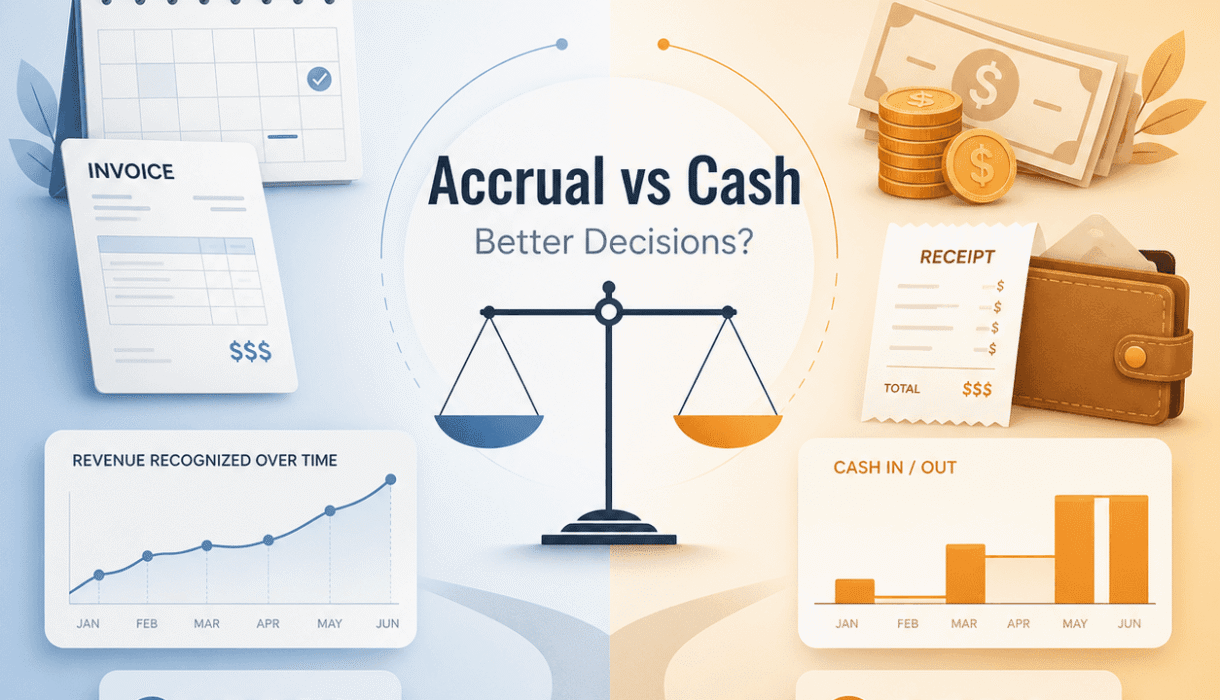
So let’s talk about it. Cash basis vs accrual basis. Which one leads to better decisions.
Spoiler: it depends on what kind of decisions you’re trying to make. And how clean your books are in the first place.

First, what cash basis really tells you
Cash basis accounting is simple:
You record income when money hits your bank account.
You record expenses when money leaves your bank account.
That’s it.
So if you do a job in March, invoice the client in March, but they pay you in April, cash basis says. Nope. That income is April income.
Same thing with bills. If you receive a bill in March but you pay it in April, then cash basis pushes it into April.
Cash basis is basically a bank statement with categories and maybe some structure around it.
And honestly. For some businesses, that’s not an insult. It’s exactly what they need.
However, it’s important to note that the choice between cash and accrual accounting can significantly impact financial reporting and decision-making processes.
Cash basis is good for decisions like:
- “Can I afford to buy this equipment right now?”
- “Do I have enough cash to run payroll on Friday?”
- “Should I hold off on that marketing spend until next month?”
- “Why is my bank balance shrinking?”
If your main stress is cash flow, cash basis is comforting because it maps pretty closely to your real life.
But it can also trick you. A lot.
Accrual basis, in plain English
Accrual accounting records income when it’s earned, and expenses when they’re incurred. Regardless of when cash moves.
So that March job you invoiced in March. Under accrual, it’s March revenue even if you get paid in April.
And that bill you received in March. Under accrual, it’s a March expense even if you pay it in April.
This is where terms like Accounts Receivable (A/R) and Accounts Payable (A/P) show up. And also why accrual reports can look “wrong” if you’re used to staring at the bank balance.
But accrual is better at one specific thing.
It matches activity to the period it actually happened in. Which makes profitability way more real.

The real question: what does “better decisions” mean?
When business owners say “better decisions,” they usually mean one of these:
- Better pricing decisions
- Better hiring and payroll decisions
- Better decisions about growth, marketing, inventory, or capacity
- Better decisions about cash flow and timing
- Better decisions about taxes
- Better decisions about what’s actually profitable
Cash and accrual don’t answer all of those equally well.
So let’s break it down in a practical way.
Decision type #1: pricing and profitability decisions
If you’re trying to answer:
“Are we actually making money on what we sell?”
Accrual usually wins. Pretty hard.
Because cash basis can show a great month that’s not actually great, and a terrible month that’s not actually terrible. It depends on collections and payment timing.
Quick example (service business)
- You complete $60,000 of work in June.
- You invoice $60,000 in June.
- Clients pay only $25,000 in June and the rest in July.
Under cash basis, June revenue is $25,000.
Under accrual, June revenue is $60,000.
If you’re trying to decide whether your pricing works, cash basis just gave you a misleading answer. It made June look weak, even though you were busy and produced real work.
And the reverse can happen too. Maybe July looks amazing just because collections hit.
The “false confidence” problem (cash basis)
Cash basis can cause you to think:
- “We’re crushing it, let’s hire!” when really you just collected old invoices and your current month sales are slowing.
Accrual reduces that noise.
If you want decision ready financials for profit decisions, accrual is generally the better tool.
Decision type #2: payroll and hiring decisions
Payroll is one of the biggest commitments most businesses make. It’s recurring, it’s emotional (people depend on it), and it’s hard to undo quickly.
So the hiring question is usually:
“Can the business support this role long term?”
Cash basis answers:
- “Can I pay them this month?”
Accrual answers:
- “Is this business model profitable enough to support them if revenue and expenses are matched correctly?”
And ideally, you want both answers. Because both matter.
One thing that helps either way: better payroll systems
If you’re still doing payroll in a messy way (manual entries, unclear liabilities, random reimbursements), your financials will always feel slightly off.
If you’re considering switching or starting payroll software, Smart Bookkeeping Partner recommends Gusto, and there’s also a promo tied to it:
Use this referral link: https://gusto.com/r/everylanne4b19bb6
Once you sign up using that link and run your first paid bill, you’ll receive $200 worth of gift cards.
That doesn’t fix accrual vs cash, obviously. But clean payroll + clean books makes either method more useful.
Decision type #3: marketing and growth spend
Marketing decisions are usually based on return.
Not immediate cash return necessarily, but return over time.
Cash basis will show marketing as an expense when it’s paid, which can clobber one month and make the next month look better.
Accrual can still show the marketing expense when incurred, but here’s the bigger point.
Accrual makes it easier to compare:
- revenue generated in a period
- to expenses incurred to generate that revenue
If you’re trying to evaluate performance month by month, cash basis creates timing distortion.
That said, there’s a catch.
If your accrual books are sloppy, accrual will lie louder.
Accrual only works if:
- invoices are recorded correctly
- bills are entered correctly
- A/R and A/P are reconciled and believable
- revenue recognition makes sense for your business (especially if you take deposits, sell packages, or have long projects)
If those pieces aren’t in place, accrual reports feel confusing and untrustworthy.
Which is why a lot of owners abandon accrual and go back to cash.
Not because accrual is bad. But because their accrual data is not clean.
Decision type #4: cash flow decisions (the one cash basis is built for)
If the decision is:
“Will I run out of money?”
Cash basis is closer to the truth.
But I’m going to say something that surprises people.
Cash basis is not the same as cash flow management.
Cash basis is just cash timing in your P&L.
Actual cash flow management is about:
- what’s coming in (A/R)
- what’s going out (A/P, payroll, taxes, debt)
- when those things hit
- and what you can control
So cash basis helps. But it still doesn’t show what’s owed to you unless you’re tracking receivables somewhere else. Same with bills you haven’t paid yet.
This is why many businesses do well with a hybrid decision setup:
- Use accrual for profit and performance decisions.
- Use cash flow tracking/forecasting for survival and timing decisions.
This is the kind of thing Smart Bookkeeping Partner does a lot in CFO advisory style support. Clean books first, then layers like cash flow monitoring, forecasting, KPI tracking.
Because the decision you’re trying to make changes what report you should be staring at.
Decision type #5: tax decisions
Cash basis often wins for taxes. Not always, but often.
Because cash basis can allow more control over timing. For example:
- delay invoicing to push income into the next tax year (careful here)
- accelerate bill payments to pull deductions into the current year
But you don’t want to make business decisions only for taxes.
A tax smart decision that creates operational chaos is still a bad decision.
Also, tax rules and eligibility for cash basis can depend on your entity type, revenue, and industry, so talk to your tax pro before changing methods.
A simple way to choose: what kind of business are you?
Here’s a quick gut check. Not law. Not tax advice. Just real world patterns.
Cash basis tends to work fine when:
- You get paid immediately (or close to it)
- You don’t have many unpaid bills sitting around
- You don’t carry inventory
- You’re small and staying small for now
- Your main need is cash visibility
- You don’t do complicated projects, retainers, deposits, or multi month work
Think: some solo service providers, very small contractors, certain local businesses with immediate payment.
Accrual tends to be better when:
- You invoice clients and collect later
- You have meaningful unpaid bills at month end
- You use subcontractors or labor tied to specific jobs
- You have multiple revenue streams and need clean margins
- You’re growing and want real performance reporting
- You want KPIs you can actually trust (gross margin, net margin, etc.)
- You’re talking to lenders or investors, or just want more “real” financial statements
Think: agencies, professional services, trades with progress billing, product businesses, subscription models.
The part people skip: clean books matters more than the method
I’ve seen cash basis books that are more decision ready than messy accrual books.
And I’ve seen accrual books that are technically accrual, but A/R is full of old invoices that will never be collected, A/P is missing, and revenue is in random accounts. That’s not accrual. That’s just confusion with extra steps.
Before you debate cash vs accrual, make sure basics are solid:
- bank and credit cards reconciled monthly
- transactions categorized consistently
- payroll mapped correctly (wages, taxes, benefits)
- loan payments split between interest and principal
- A/R reflects real collectible invoices
- A/P reflects real unpaid bills
- owner draws and distributions not mixed into expenses
- sales tax and payroll liabilities tracked correctly
If you’re not sure where you stand, Smart Bookkeeping Partner offers a free QuickBooks health check where they review how transactions are recorded, what’s reconciled, what cleanup is needed, then walk you through the findings.
Website: https://smartbookkeepingpartner.com/
Phone: 985-401-1210
That health check is often the moment where the cash vs accrual conversation becomes obvious, because you can actually see what your current books can support.

A decision focused comparison (not a textbook one)
Here’s the cleanest way I know to say it.
Cash basis helps you decide:
- “Can I pay for this?”
- “How much cash did I collect?”
- “What did I actually spend?”
- “What is my bank balance doing?”
Accrual helps you decide:
- “Did we earn money this month?”
- “Are we profitable, really?”
- “What are our margins?”
- “Are we improving or getting worse over time?”
- “What’s the true cost to deliver what we sold?”
- “Which service line is carrying the business?”
- “Is the business model working?”
So which makes better decisions?
Accrual makes better performance decisions.
Cash makes better timing decisions.
Most growing businesses eventually need both views.
Common scenarios where cash basis leads to bad decisions
1) You have a big “profit month” that’s just late payments arriving
You collect on a pile of old invoices. Cash basis P&L shows an amazing month.
You celebrate. You expand spend. You feel safe.
But the current month sales pipeline might be slow, and your next month collections will dip.
Accrual would have shown that the “amazing month” was just cash timing, not actual performance.
2) You cut expenses because a month looks bad, but it’s just payment timing
Maybe you prepaid insurance. Maybe you paid annual software renewals. Maybe you caught up on vendor bills.
Cash basis makes the month look awful.
So you cut marketing or delay hiring, even though the underlying business is healthy.
Accrual would smooth those timing distortions, assuming it’s set up properly.
3) You price services too low because you’re not matching labor and job costs
Cash basis often hides the true cost of delivery.
If you’re paying contractors after the fact, or carrying job costs into next month, cash basis can make individual months look better than the jobs actually were.
Accrual, especially with job costing or class tracking done right, gives you a clearer “this job made money / this job lost money” view.
Common scenarios where accrual basis leads to bad decisions
Yes, accrual can also mess people up. Usually because they look at accrual P&L but ignore cash reality.
1) You feel profitable, but you’re cash poor
Accrual might show a strong month because you earned revenue.
But if clients are slow to pay, your bank account still hurts.
This is where you need A/R tracking and cash flow forecasting, not just accrual reporting.
2) Your A/R is inflated with uncollectible invoices
Accrual revenue is only meaningful if receivables are real.
If old invoices never get written off, accrual reports overstate income historically. You think you’re doing better than you are.
3) Your books are technically accrual, but nobody is maintaining them
Accrual requires process. Someone has to:
- send invoices properly
- record bills properly
- reconcile accounts
- clear out old items
- review aging reports
- adjust for deposits or deferred revenue when needed
If that’s not happening, accrual becomes a fancy label on messy data.
So, which should you use in QuickBooks?
Most businesses using QuickBooks Online can toggle between cash and accrual reports.
That’s actually useful. You can run both.
But the default for decision making should match what you’re trying to manage.
If you want one simple approach that works for most owners:
- Keep books maintained in a way that supports accrual reporting (accurate A/R and A/P).
- Review accrual P&L monthly for performance.
- Review cash flow and bank balance weekly for timing.
- Use cash basis reporting for tax planning if your CPA recommends it.
In other words, don’t pick a side like it’s a personality type. Use both views, intentionally.
A quick wrap up (because you probably have 12 other tabs open)
If your goal is better decisions, here’s the honest answer:
- Accrual accounting usually leads to better decisions about profitability, pricing, and performance.
- Cash basis usually leads to better decisions about short term cash and timing.
And the bigger truth sitting underneath both.
Your method won’t save you if your books aren’t clean.
If you want help getting to decision ready financials, or you’re not sure whether your current setup is helping or hurting, you can start with the free QuickBooks health check from Smart Bookkeeping Partner (they review what’s reconciled, how things are recorded, what needs cleanup, then walk you through it).
https://smartbookkeepingpartner.com/
985-401-1210
And if payroll is part of your cleanup or you’re switching providers, here’s the Gusto referral link again. It includes Smart Bookkeeping Partner’s promo for new Gusto clients:
https://gusto.com/r/everylanne4b19bb6
After your first paid bill, you’ll receive $200 worth of gift cards.
That’s it. Pick the view that matches the decision. And make sure the data is real.
FAQs (Frequently Asked Questions)
What is the main difference between cash basis and accrual basis accounting?
Cash basis accounting records income and expenses only when cash actually moves in or out of your bank account, while accrual basis accounting records income when it’s earned and expenses when they’re incurred, regardless of cash movement.
Which accounting method is better for understanding my business’s true profitability?
Accrual basis accounting is generally better for assessing true profitability because it matches income and expenses to the period they actually happen, providing a more accurate picture than cash basis, which can be misleading due to timing differences.
How does cash basis accounting help with managing cash flow decisions?
Cash basis accounting closely reflects your actual bank balance, making it useful for decisions like determining if you can afford equipment purchases, run payroll on time, or delay marketing spend based on real-time cash availability.
Can using cash basis accounting cause false confidence in business performance?
Yes. Cash basis can make a month look great simply because you’ve collected old invoices, not because current sales are strong. This can lead to premature hiring or spending decisions that aren’t supported by the underlying business activity.
Why might a business choose accrual accounting despite its complexity?
Accrual accounting provides a clearer view of financial health by matching revenues and expenses to their actual periods, which helps with better pricing, hiring, growth planning, and understanding true profitability—critical for long-term strategic decisions.
How do payroll and hiring decisions relate to choosing between cash and accrual accounting?
Cash basis helps answer if you have enough money this month to pay employees, while accrual basis shows if your business model is profitable enough over time to support new hires sustainably. Ideally, both perspectives inform payroll decisions.